LLMs form the linguistic backbone of Conversational AI. Check out how Livserv.ai uses ChatGPT to power up conversational AI for sales.
Training Large Language Models (LLMs) for sales purposes is a strategic endeavor. The integration of LLMs in conversational AI systems has been a game-changer, transforming the way businesses engage with their customers.
By exploring best practices in using LLM in conversational AI, businesses can facilitate personalized and engaging conversations, streamline lead generation, and revolutionize customer interactions.
Continue reading further to delve into the intricacies of training LLMs for sales, where artificial intelligence is propelling the sales process into a new era of efficiency and customer satisfaction.
What is LLM?
LLM stands for “Large Language Model.” It refers to a type of artificial intelligence model that is trained on vast amounts of text data to understand and generate human-like language. These models, often based on deep learning techniques, can comprehend the context of a given input and generate coherent and contextually relevant outputs.
LLMs handle a wide range of natural language understanding tasks, including question answering and more. Some examples of LLMs are OpenAI’s GPT, Google’s BERT, Meta’s RoBERTa, and others.
What is Conversational AI?
Conversational AI, or Conversational Artificial Intelligence, refers to the use of artificial intelligence systems to engage in natural language conversations with humans. The goal of Conversational AI is to create human-like interactions between computers and users, making it possible for machines to understand, interpret, and respond to spoken or written language.
Key components of Conversational AI include:
- Natural Language Processing (NLP): The ability of a system to understand and interpret human language, including the context, semantics, and intent behind the words.
- Machine Learning: Algorithms that enable the system to learn and improve its performance over time based on the data it receives and user interactions.
- Speech Recognition: In the case of voice-based interactions, Conversational AI systems often incorporate speech recognition technology to convert spoken words into text.
- Dialog Management: The capability to maintain context and manage the flow of a conversation, ensuring coherence and relevance in responses.
- User Interface: The interface through which users interact with the Conversational AI system, which can be a chat interface, voice interface, or other communication channels.
Conversational AI finds applications in various domains, including customer support, virtual assistance, e-commerce, healthcare, and more. It aims to provide a more natural and efficient way for users to interact with technology, reducing the barrier between humans and machines.
How are LLM and Conversational AI Linked?
Large Language Models (LLMs) and Conversational AI are intricately linked, with LLMs serving as a foundational technology within the broader scope of Conversational AI.
LLMs are advanced language generation models trained on massive datasets to understand and produce human-like text. When integrated into Conversational AI systems, LLMs play a pivotal role in enhancing the system’s natural language understanding and response generation capabilities.
Conversational AI leverages LLMs to process and comprehend user inputs in a way that closely mimics human conversation. These models enable the AI system to not only recognize the semantics and intent behind user queries but also to generate contextually relevant and coherent responses.
LLMs contribute to the fluidity and richness of the conversational experience, allowing the AI to adapt to various contexts, handle diverse user inputs, and provide more personalized and engaging interactions.
In essence, LLMs form the linguistic backbone of Conversational AI, empowering machines to communicate with users in a manner that is increasingly indistinguishable from human conversation.
Best Use Cases of LLM for Sales
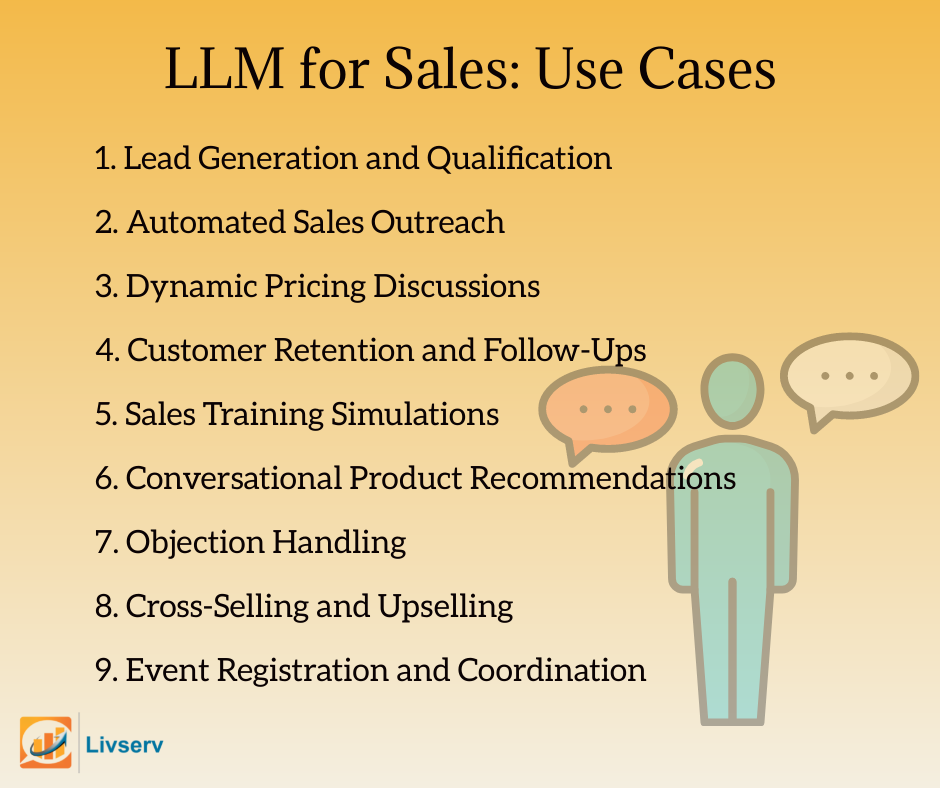
Figure 1: Use Cases of LLM for Sales
Large Language Models (LLMs) have shown great promise in revolutionizing the sales process by providing advanced natural language understanding and generation capabilities. Here are some of the best use cases for integrating LLMs in sales:
| Lead Generation and Qualification | Automated Sales Outreach | Dynamic Pricing Discussions |
| Customer Retention and Follow-Ups | Sales Training Simulations | Conversational Product Recommendations |
| Objection Handling | Cross-Selling and Upselling | Event Registration and Coordination |
Lead Generation and Qualification: LLMs can assist in lead generation by engaging potential customers in natural and personalized conversations. Through chat interactions, they can qualify leads by asking relevant questions, understanding customer needs, and assessing the likelihood of conversion. Livserv is built to serve this. Talk to our experts to learn more.
Automated Sales Outreach: Automate initial sales outreach through LLM-powered chatbots. These bots can handle introductory conversations, answer common questions, and even schedule appointments, freeing up human sales representatives to focus on more complex tasks. Check out more about contact center automation using chatbots here.
Dynamic Pricing Discussions: LLMs can facilitate dynamic pricing discussions by understanding customer inquiries and negotiating within predefined parameters. This enables businesses to provide personalized pricing options, discounts, or incentives based on the customer’s needs and negotiation style.
Customer Retention and Follow-Ups: Utilize LLMs to automate customer follow-ups and retention efforts. These models can engage with customers post-purchase, gather feedback, and address concerns, fostering a positive relationship and increasing the likelihood of repeat business. Livserv’s integration with CRM and WhatsApp can help you achieve it.
Sales Training Simulations: Create realistic sales training simulations using LLMs to help sales teams practice and improve their conversational skills. These simulations can simulate various customer scenarios, allowing sales representatives to refine their techniques in a risk-free environment.
Conversational Product Recommendations: Enhance the visitor experience by using LLMs to provide personalized product recommendations through natural language interactions. By understanding customer preferences and requirements, the LLM can suggest products that align with the customer’s needs.
Objection Handling: Train LLMs to handle common objections and concerns raised by potential customers. By providing well-crafted responses, LLMs can address objections in real-time, helping to overcome barriers and move the sales process forward.
Cross-Selling and Upselling: Enhance cross-selling and upselling efforts by training LLMs to identify opportunities during customer interactions. These models can suggest complementary products or upgrades based on the customer’s preferences and purchase history. Explore Real Estate LLM solutions for upselling here.
Event Registration, Appointments, and Coordination: Use LLMs to handle event registrations and coordination. Whether it’s a webinar, product demonstration, or in-person event, LLMs can manage the registration process, provide event details, and answer attendee queries. Explore Healthcare LLM solutions here.
How to Use LLM in Conversational AI
To begin, it’s essential to choose a suitable LLM model based on the specific requirements of the Conversational AI project. We are already running our conversational AI builder on GPT.
Next, defining clear use cases, whether it’s customer support, lead generation, or information retrieval, provides a focused direction for training. The preparation of a diverse and representative dataset is crucial, encompassing various conversational scenarios to ensure the model’s adaptability.
Livserv’s AI chatbot builder offers powerful training features with company documents or webpage URLs. You may further fine-tune the LLM on task-specific data and refine its responses to align with the nuances of your brand value. Livserv allows you to add canned responses for the same.

Figure 2: Training UI of Livserv.ai dashboard
Further, ensure your Conversational AI can seamlessly integrate with various communication channels. Livserv offers robust integrations on websites, WhatsApp, and Facebook.
Additionally, Livserv allows you to regularly evaluate the performance of your Conversational AI. Gather user feedback, monitor key performance indicators (KPIs), and make iterative updates to both the LLM and the overall system to enhance effectiveness over time.
It is now understood that integrating Large Language Models into Conversational AI opens up exciting possibilities for creating engaging and human-like interactions. By carefully selecting the right LLM, defining clear use cases, preparing high-quality data, and implementing context awareness, you can build a Conversational AI system that not only understands but also enriches user conversations.
Livserv can help you build a conversational AI for your business. Talk to our experts today.